
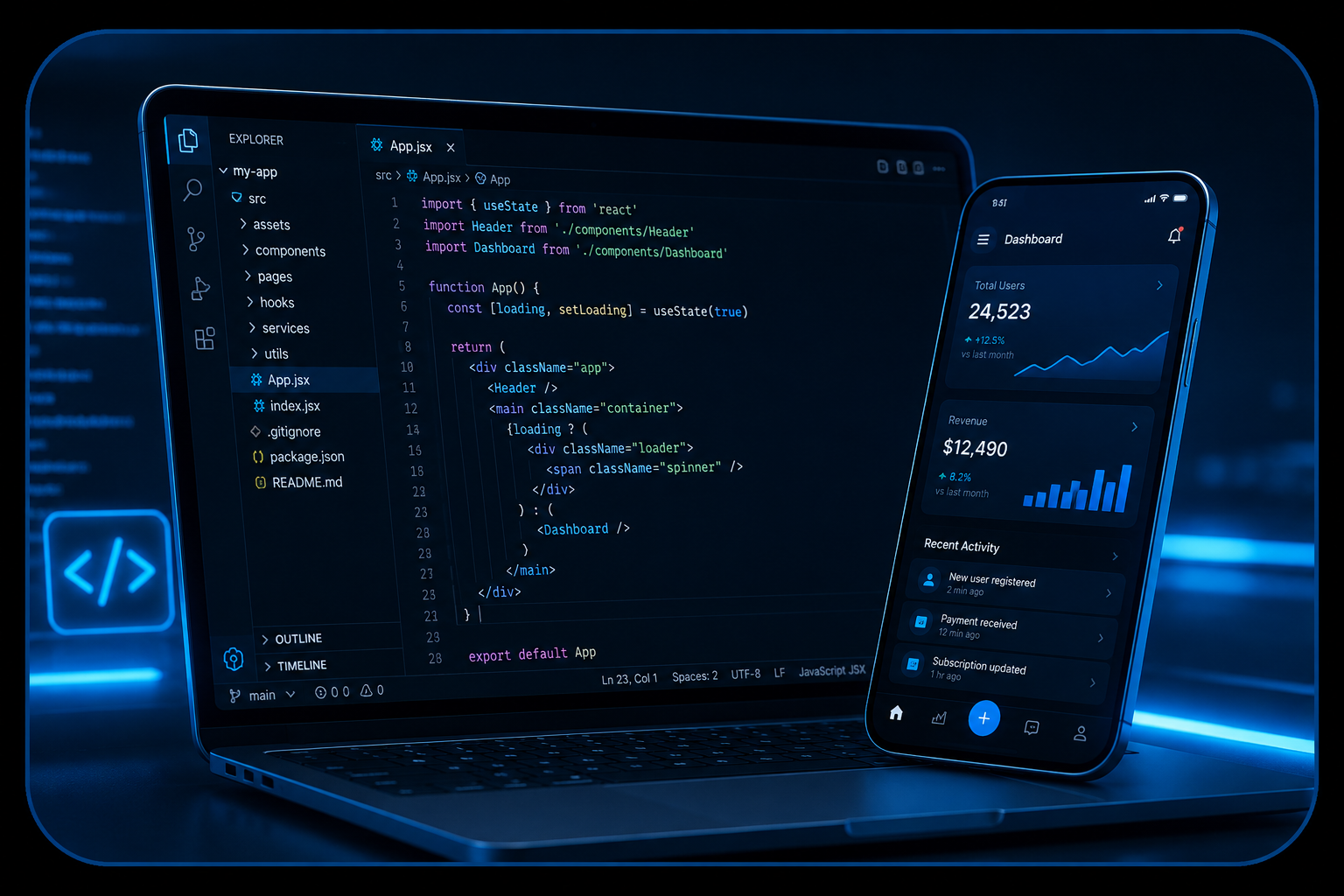
When a business process no longer fits inside a standard website, a custom web application can bring structure, automation and visibility to the work. Livasys designs and develops web applications around real workflows, users, data and measurable outcomes.
Start with the workflow, not the technology
A useful application begins with understanding what people actually do. We map users, permissions, inputs, decisions, approvals, outputs and exceptions before choosing the technical approach. This prevents the common mistake of building features that sound impressive but do not solve the underlying process. The result is a product that reflects the way the organization works and provides a clearer experience for its users.
Custom portals and business platforms
Applications can support customer portals, internal dashboards, project workflows, booking systems, CRM-style tools, ecommerce functions, reporting interfaces and other specialized processes. Livasys can design interfaces around the roles that use them. A customer may need simplicity, while an administrator may need detailed controls and reporting. Role-aware design keeps the experience focused.
Scalable architecture
Applications often evolve after launch. We therefore consider how new users, records, integrations and features can be added without forcing a complete rewrite. Architecture, data models, APIs and reusable components are planned with growth in mind. The right level of abstraction is important: the system should be extensible without becoming unnecessarily complicated.
Modern front-end experiences
Users expect web applications to feel responsive and predictable. We can build modern interfaces using technologies such as React when they are appropriate for the project. We focus on clear states, useful feedback, validation, responsive layouts and accessible interactions. A dashboard should make important information easy to understand, while a complex workflow should guide the user rather than overwhelm them.
APIs and integrations
Many applications need to exchange information with other systems. We can work with APIs, payment services, email systems, analytics platforms and other third-party tools. Integrations are designed with validation, authentication, error handling and data consistency in mind. When an external service changes or becomes unavailable, the application should fail gracefully rather than leaving users with unexplained errors.
Security and permissions
Business applications often handle sensitive operational information. Security considerations can include authentication, role-based permissions, input validation, secure data handling, audit trails and protected administrative functions. The exact controls depend on the application and data involved, but security should be considered from architecture through deployment rather than added as a final layer.
Testing and quality assurance
Application quality depends on more than visual polish. We test critical workflows, forms, permissions, integrations, error states and responsive behavior. Where appropriate, testing can cover different user roles and edge cases. The goal is to identify problems before users encounter them in production and to make future changes safer.
Deployment and ongoing support
Launching an application is the beginning of its operational life. We can support deployment, configuration, monitoring and maintenance so the platform remains useful as the business changes. Updates can be planned around user feedback, new requirements, security needs and performance observations. A maintainable application gives the organization more flexibility over time.
When should you consider a web application?
A custom application is worth considering when spreadsheets, email chains or disconnected tools are creating repeated work, poor visibility or manual errors. If multiple people need to interact with the same data or process, a centralized application can create clearer accountability and faster workflows. We can help assess whether custom development is justified before committing to a large build.
What the engagement can include
A web application engagement can include discovery, workflow mapping, information architecture, UI design, front-end development, back-end development, database design, APIs, authentication, permissions, testing, deployment and maintenance. We begin by separating essential workflows from nice-to-have features so the first release can focus on the highest-value problems. Where appropriate, an MVP approach can reduce time to learning and allow real users to shape later iterations. We also think about operational needs such as administration, reporting, error handling, backups and support. A technically impressive application that is difficult to operate is not a successful product. The interface should make the next action obvious, while the underlying system should protect data and handle unexpected conditions predictably. As requirements grow, reusable components and clear APIs can make new functionality easier to introduce. This makes the application a long-term business asset rather than a one-off project that becomes impossible to change after launch.
Before we begin
Useful inputs include a description of the current workflow, user roles, data sources, approval steps, reports, integrations, security requirements, expected user volume and the most important problem the application needs to solve.
Designed around the people who use the system
A successful application reduces cognitive load. Users should understand where they are, what information matters and what action is available next. We use clear hierarchy, meaningful labels, validation and useful feedback to make workflows easier to complete. Administrative users may receive deeper controls while customers see a simpler experience. This balance is especially important for applications that are used every day, because small sources of friction can multiply into significant operational costs over time.
Planning for future growth
As the application proves its value, new roles, reports, integrations and workflows may be introduced. A clear architecture makes those additions easier to evaluate and implement. We can prioritize improvements using user feedback, operational impact and business value so development effort stays focused on the problems that matter most. This creates a practical path from an initial application release to a more capable platform without losing the simplicity that made the first version useful.
Frequently Asked Questions
What types of web applications do you build?
Examples include portals, dashboards, workflow systems, customer management tools, booking platforms, project tools and other custom business applications.
Can you integrate an application with existing software?
Yes. APIs and third-party integrations can be planned around the existing systems and business workflow.
Which technologies can you use?
Depending on requirements, Livasys can work with technologies such as React, Node.js, PHP, Laravel and other suitable web technologies.
Do you maintain applications after launch?
Yes. Ongoing support can include bug fixes, updates, performance improvements, security work and feature enhancements.